I have nothing against opulence. I love silk scarves, nice clothes (though I eventually spill tea or splatter tomato sauce on everything), an excess of life's accessories stuffed into closets and corners. The trick with any system—capitalism, socialism, trade-and-barter, utopianism—is to ensure that outward opulence is a projection of —not substitute for — the soul and psyche of individuals in that society. Has this ideal ever been achieved?
We seem to be a long way from this today, the dawn following another mass murder fueled by hate, an opulence of metal and bullets and blood that is, alas, closer to the projection of our broken souls and gaunt psyches. It is easy to walk down Madison Avenue in Manhattan and blame the mass-marketed, sterile opulence of the window displays for everything that is wrong in ourselves.
Well-dressed mannequins watch as winter takes hold; well-dressed mannequins watch as we lose hold.
Thoughts on poetry, creativity, education, the world as we know it, the world as it should be...
Sunday, October 28, 2018
Monday, October 8, 2018
Shadow Ways
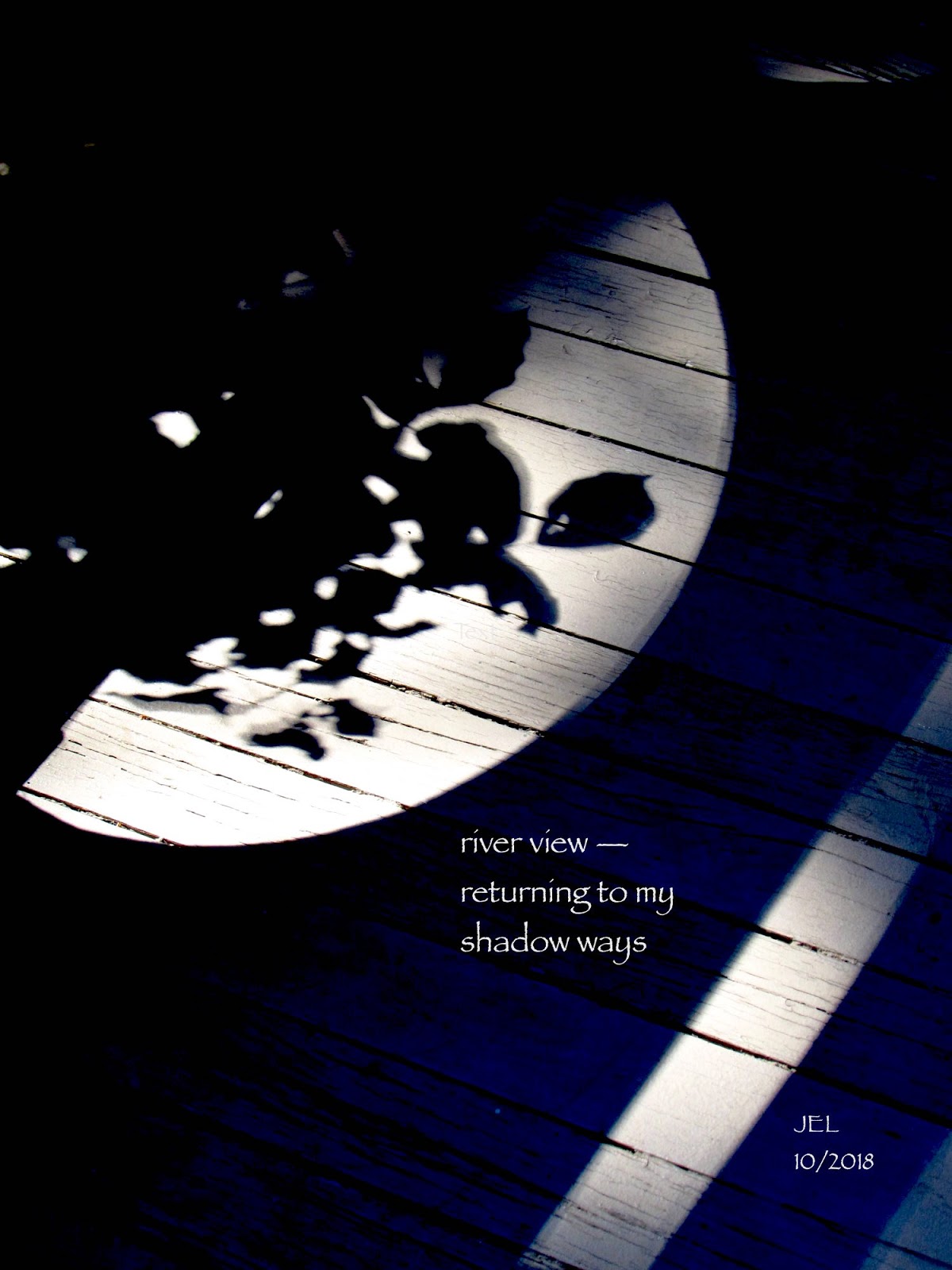
Things seem to go from worse to I-can't-believe-this-has-gotten worse. Still, one can walk out-of-range of any electronic or print media and find at least a moment of respite. Beauty abounds, despite the human propensity to destroy what is beautiful. The natural world continues to amaze, and artists continue to provide inspiration.
Each of us must remember to allow some time for shadows, for the quiet time out of the sun or spotlight or screen or glare of anything glare-y. It's not "going dark," but taking time to look within, or aside, or down. A time to see patterns, juxtapositions, opposites, alternatives. Beauty in unexpected places. Reason to take another step or half-step forward.
Onward we go.
*
river view—
returning to my
shadow ways
Each of us must remember to allow some time for shadows, for the quiet time out of the sun or spotlight or screen or glare of anything glare-y. It's not "going dark," but taking time to look within, or aside, or down. A time to see patterns, juxtapositions, opposites, alternatives. Beauty in unexpected places. Reason to take another step or half-step forward.
Onward we go.
*
river view—
returning to my
shadow ways
Sunday, August 19, 2018
Sense of Self: What We Name, We Are
Bindweed. Creeper vine. Bittersweet. An August bounty of weeds. Some cool morning, I'll be in the little patch of garden trying to tear out the vines. The vines will win.
I will come away with even more metaphors for how a garden is life. More metaphors for one's sense of self, one's exploration of identity, one's reasons for persisting.
The vines, the semi-wild perennials, the sweet-scented rose. Too much sun and too much rain, both.
All building up to that killing frost...
Now she's lost her wits, you'd say, talking about frost on a summer day.
And you'd be right!
I will come away with even more metaphors for how a garden is life. More metaphors for one's sense of self, one's exploration of identity, one's reasons for persisting.
The vines, the semi-wild perennials, the sweet-scented rose. Too much sun and too much rain, both.
All building up to that killing frost...
Now she's lost her wits, you'd say, talking about frost on a summer day.
And you'd be right!
Sunday, July 29, 2018
Sense of Self (3)
How are the pieces put together—that's one way to look at the concept of "self."
Where do the pieces come from—that may be the more instructive question, especially from the point of view of an artist or poet.
Another challenge is to remember to ask about what isn't there, which means realizing there's a missing piece (or two or a thousand) before one is even close to completing the puzzle. And of course, a lost piece (a piece of loss) is still a piece of the puzzle of self.
I have recently read a couple biographies that struggle with this very thing, the pieces that go into the making of the person, the "life lessons" that shaped (or warped) the person's world view, the way loss factored in, the pieces that the person fought to keep despite all odds...It is overwhelming when one thinks of a biographer snooping around, picking out what seem to be the significant pieces.
And why always pieces? Is any part of us whole? Ever? No? Maybe in the way that a collage is whole, or a quilt?
Collage as autobiography...
Where do the pieces come from—that may be the more instructive question, especially from the point of view of an artist or poet.
Another challenge is to remember to ask about what isn't there, which means realizing there's a missing piece (or two or a thousand) before one is even close to completing the puzzle. And of course, a lost piece (a piece of loss) is still a piece of the puzzle of self.
I have recently read a couple biographies that struggle with this very thing, the pieces that go into the making of the person, the "life lessons" that shaped (or warped) the person's world view, the way loss factored in, the pieces that the person fought to keep despite all odds...It is overwhelming when one thinks of a biographer snooping around, picking out what seem to be the significant pieces.
And why always pieces? Is any part of us whole? Ever? No? Maybe in the way that a collage is whole, or a quilt?
Collage as autobiography...
Sunday, July 15, 2018
Saturday, July 14, 2018
Sense of Self: The Keeper of...
Last month was "depth of being" month here on the ol' blog. This month, I'm transitioning into "sense of self." The book I'm reading has me thinking of what goes into the making of one's sense of self, and how that includes all that is lost along the way. Loss as part of the creative process—that's the paradox I'm seeing as I read the memoir of a famous novelist who took a non-fiction detour to explore her family.
It is one thing to keep what one has—that is challenge enough, trying to hold onto love, sanity, friendships, purpose, temper, plus all the many tangible items one hopes never to lose. But to be a keeper of what has been lost—ah, that's the stuff of poetry and art. Of course, one thinks of Elizabeth Bishop's poem "One Art" here (please google it and read it if you aren't familiar with it). But for an avid reader such as myself, it's massive to think back over the past dozen or so books I've read and realize, they are all about the "art" of losing. Louise Erdrich said about stories that they are about change and "learning to hold on to what's important" as change happens.
And by change, we mean loss. Even what seems like a gain—a positive change—is accompanied by the sudden onslaught of the fear of loss.
Continued anon!
It is one thing to keep what one has—that is challenge enough, trying to hold onto love, sanity, friendships, purpose, temper, plus all the many tangible items one hopes never to lose. But to be a keeper of what has been lost—ah, that's the stuff of poetry and art. Of course, one thinks of Elizabeth Bishop's poem "One Art" here (please google it and read it if you aren't familiar with it). But for an avid reader such as myself, it's massive to think back over the past dozen or so books I've read and realize, they are all about the "art" of losing. Louise Erdrich said about stories that they are about change and "learning to hold on to what's important" as change happens.
And by change, we mean loss. Even what seems like a gain—a positive change—is accompanied by the sudden onslaught of the fear of loss.
Continued anon!
Saturday, June 23, 2018
Depth of Being, part 5
alone in the dark
each of us —
dancer at rest
Far from home, my m.o. is to visit the homes of others who are long gone. Homes that once had an occupant of historic standing, and are therefore now sacred ground of some sort, worthy of pilgrimage. A place where ideas were fleshed out into acts or visual or verbal representations; a place where depth of being was explored and given some sort of outward manifestation that was then shared with others.
Yesterday it was the home of sculptor Daniel Chester French, whose most famous work is the sitting Lincoln in Washington, D.C.'s Lincoln Memorial. You may also know the Minuteman on Concord's North Bridge. Or the statue of John Harvard on the grounds of the college that bears his name.
What depths of being did I perceive as I observed the smaller-scale models of French's works? Complexity of character that could focus on a goal larger than the sum of the complexities, rather than being derailed by those contradictions, complexities, and even hypocrisies. I mean, Lincoln. One can almost feel, looking from that clenched fist to the open hand and back, the internal struggles, the contradictions at internal civil war. The Lincoln in the Lincoln Memorial brings onlookers to stunned silence (onlookers who come from all over the world); the smaller models in French's studio are also capable of bringing one to tears, as my husband and I can attest. It was on this smaller scale that I was able to begin to contemplate the depth of being that French had made visible, the conscious struggle of a human being of the best way to be both human being and leader of a nation at war with itself. Compassion: to suffer with.
each of us —
dancer at rest
Far from home, my m.o. is to visit the homes of others who are long gone. Homes that once had an occupant of historic standing, and are therefore now sacred ground of some sort, worthy of pilgrimage. A place where ideas were fleshed out into acts or visual or verbal representations; a place where depth of being was explored and given some sort of outward manifestation that was then shared with others.
Yesterday it was the home of sculptor Daniel Chester French, whose most famous work is the sitting Lincoln in Washington, D.C.'s Lincoln Memorial. You may also know the Minuteman on Concord's North Bridge. Or the statue of John Harvard on the grounds of the college that bears his name.
Subscribe to:
Posts (Atom)